
Fake Medicine Batches in Pakistan: How to Check Your Medicine
Open this article in the interactive app
Pakistan's drug regulator, DRAP (Drug Regulatory Authority of Pakistan), has issued a nationwide rapid alert after its Drug Testing Laboratory in Karachi tested samples of some well-known medicines and declared them falsified. Only the specific batches below are named. Other batches of the same medicines are not part of this alert.
What does it mean?
Pakistan's drug regulator, DRAP (Drug Regulatory Authority of Pakistan), has issued a nationwide rapid alert after its Drug Testing Laboratory in Karachi tested samples of some well-known medicines and declared them falsified — fake products made to look like the real brands.
Common causes
- What the laboratory found
Laboratory testing could not verify the active ingredients in the samples, which means there is no guarantee these products contain what their labels claim. According to the Kashmir English report of the alert, the samples did not contain their declared active ingredients, and the manufacturers denied producing them. A medicine like this cannot be trusted to treat anything — and using it can delay real treatment. - What DRAP has directed
DRAP has directed provincial drug control departments and its field teams to seize the identified batches. Here is what you need to check at home. - The batches named in the alert
Only the specific batches below are named. Other batches of the same medicines are not part of this alert. - Velosef 500mg Capsule
Batch number: LX3E - Augmentin 625mg Tablet
Batch number: YT9D - No-Spa Forte 80mg Tablet
Batch number: AN010 - Mucaine Suspension
Batch number: 257A088 - Nasomet Nasal Spray
Batch number: FW 099. This batch is confirmed in DRAP's official alert I/S/10-26-40 (19 Oct 2026), which lists it as Nasomet Aqueous Nasal Spray. - The new 2D barcode rule
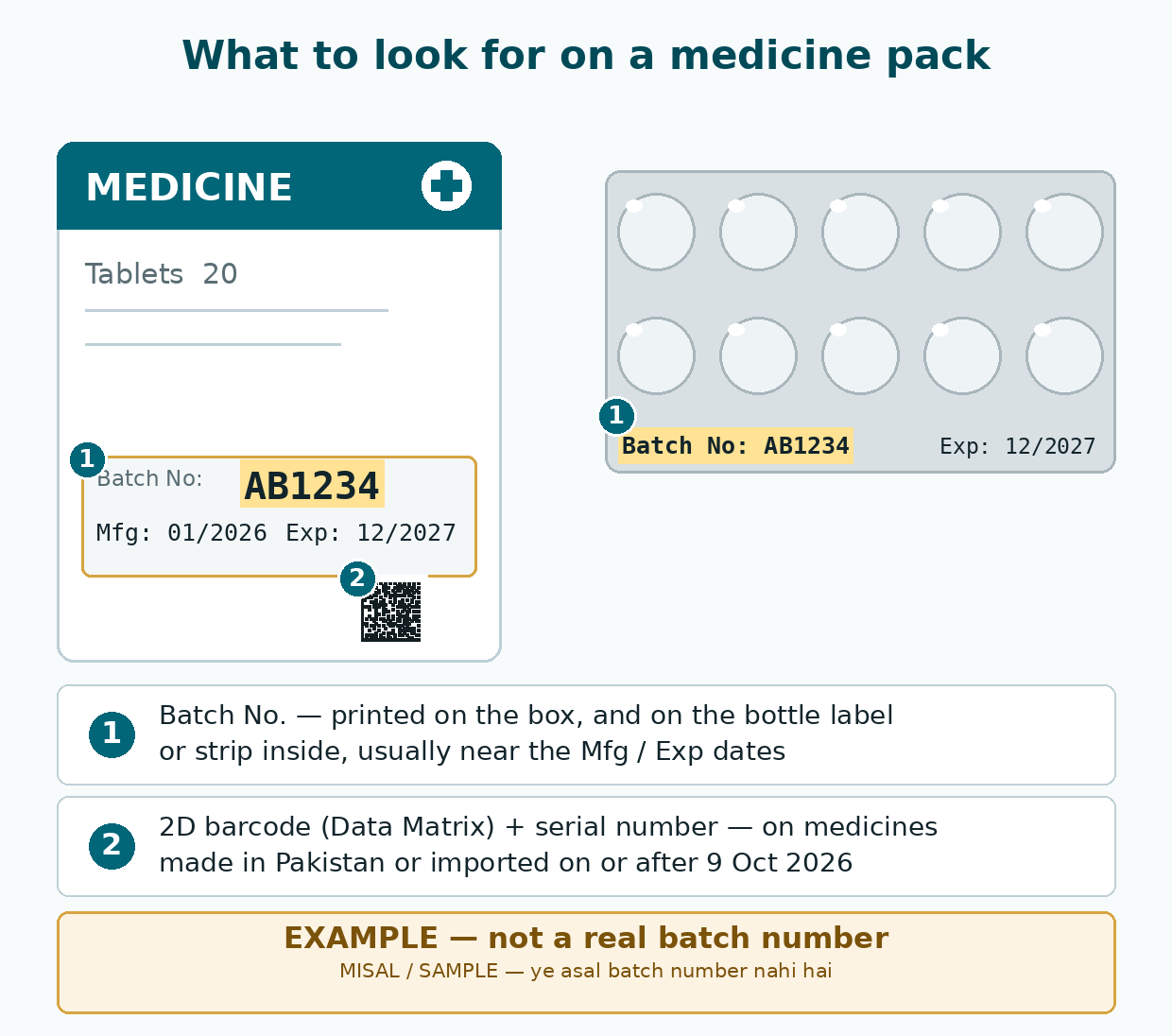
Pakistan has just switched on a long-planned protection. Under S.R.O. 963(I)/2026, the first phase of DRAP's Pharmaceutical Track and Trace System requires every medicine manufactured in Pakistan or imported on or after 9 October 2026 to carry a unique 2D Data Matrix barcode and serial number on its pack. The Health Minister has announced that a mobile app will let citizens, pharmacies and medical stores scan that code to check whether a medicine is genuine, and to see its approved price and expiry date. See also: fake flu vaccine caught: 2D barcode now mandatory. - Older stock is exempt — legally
Medicines made or imported before 9 October 2026 do not need the barcode and may still be sold. So a pack without a 2D barcode is not automatically fake. The batch-number check above remains your most reliable tool today. - The scanning app has been announced, not yet proven in everyone’s hands
As packs with the new codes fill the shelves over the coming months, scanning will become a real everyday check. Until then, treat “no barcode” as neutral — and “batch matches an alert” as the red flag that matters.
When to worry
Seek urgent medical care
If you have already taken it and feel unwell, or your condition is not improving, see a doctor and tell them exactly which product and batch you used.
Prevention & practical tips
- Find the batch number. Look on the outer carton, and also on the bottle label or blister strip inside. It is usually printed near the manufacturing and expiry dates, often labelled "Batch No.", "Lot No." or simply "B. No."
- Read it exactly. Batch codes mix letters and numbers (for example, AN010 — that is the letter A, the letter N, then 010). Copy it down carefully; a single wrong character means a different batch.
- Compare it with the table above. The medicine name and the batch number must both match for the alert to apply to your pack. If either is different, your pack is not one of the named batches.
- Check the pack itself. Blurry printing, spelling mistakes, a missing expiry date, or a seal that looks opened are all reasons to ask your pharmacist questions — whatever the batch number says.
- If your batch matches — don't panic, do this. Do not use that pack. Set it aside — do not take it, and do not give it to anyone else.
- Keep the pack. Do not throw it away. The packaging is evidence, and the pharmacist or drug inspector may need it.
- Go back to the pharmacy where you bought it, or to any licensed pharmacy, and show them the pack. You can also report it to DRAP / your provincial drug control department.
- Do not stop your treatment on your own. If this medicine was prescribed for you, speak to your doctor or pharmacist promptly about a replacement. Stopping a prescribed medicine suddenly — without a substitute — can harm you more than the delay. DRAP's reported advice is the same: do not discontinue or change prescribed treatment without consulting a healthcare professional.
- The simplest protection: where you buy. DRAP's standing advice, repeated in this alert, is to buy medicines only from licensed pharmacies and authorised outlets — not from unlicensed shops, street sellers, or informal sources. A licensed pharmacy can be asked questions, keeps proper stock, and is accountable if something is wrong. Keep your receipt when you can; it makes reporting and replacement far easier.
FAQs
References
- DRAP rapid alerts on its website: Alert I/S/10-26-43 (21 Oct 2026, four batches) and Alert I/S/10-26-40 (19 Oct 2026, Nasomet FW 099); also reported by Kashmir English (four batches) and Dunya News (five batches)
- DRAP 2D-barcode communiqué under S.R.O. 963(I)/2026 as reported by Business Recorder (13 Oct 2026) and economy.pk
- Health Minister's app announcement reported by APP (17 Oct 2026)
Only articles marked Reviewed ✓ with a date have passed Dr. Umer's medical review.
How this article was reviewed
- Written by: Dr. Muhammad Umer Farooq, MBBS — October 2026
- Medical review: Completed by Dr. Muhammad Umer Farooq, MBBS — October 2026. All medical content was provided and verified by Dr. Umer.
- Found an error? Tell Dr. Umer by email